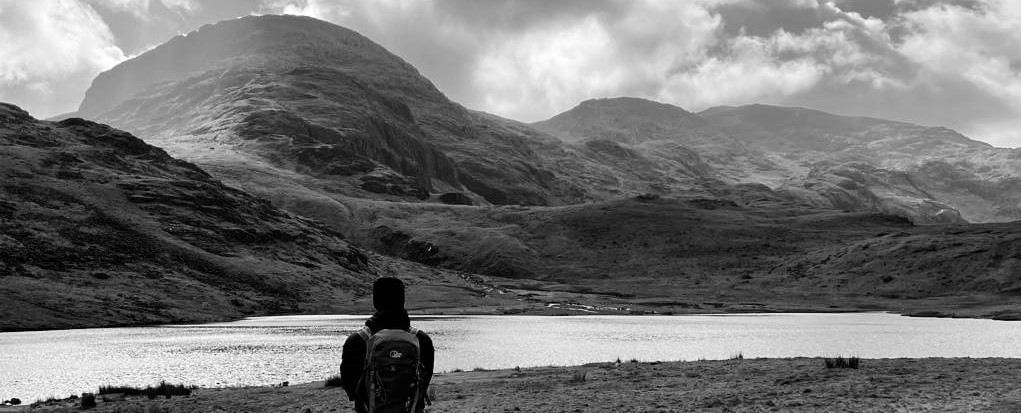
Mountains are the cathedral where I practice my religion. Anatoli Boukreev.
I like walking in mountains and spending time in them. I am drawn back by a kind of gravitational pull every month or so, even to those I’ve climbed before. I’ll head off on a Saturday morning alone or with a close friend or one of my sons. And the dog of course. Mountains seem to define some essential balance in my life. I feel cleansed by the simplicity of the elements, by how the light plays on the slopes differently in each visit, by the solitude. Choosing to be alone is not the same as loneliness, and – while this may sound odd – this experience of solitude can be a shared experience – I can walk with a friend and still have long periods of silence, which are pure peace.
Where does my help come from?
I lift up my eyes to the mountains, where does my help come from? My help comes from the Lord, the Maker of heaven and earth. He will not let your foot slip, he who watches over you will not slumber. Psalm 121.
My good friend Andy Wolfe spoke about these powerful words a few weeks ago at the National Conference of the Church of England (‘Flourishing leaders, Flourishing Schools‘). Psalms are poems, cries for help. People often reach for this particular song when they are stuck or face difficulty. In a tight spot, and looking for help the size or scale of a mountain. Mountains provide priceless capacity for wonder. For me, lifting my eyes for a few moments from the chaos or trouble in front of me can help bring perspective. When faced with current circumstances that require the benefit of perspective – the view from a mountaintop can really help. Delays and difficulties diminish when set against a wild landscape, hills and valleys. Laying present difficulties against eternal truths (that we are loved, that we are lovable), may grant us a more heavenly perspective.
Will this matter in five years’ time?
Over every mountain, there is a path, although it may not be seen from the valley. Theodore Roethke.
When a problem feels overwhelming or threatens to engulf us, these words points me towards mountains, which help to re-calculate the size of the problem in their context. Two years ago, I travelled to Northern Spain with my boys to walk in the Picos de Europa. We arrived in pitch dark night so that I could neither see where we or the mountains were. When I climbed out of bed and stood on the terrace, they loomed high above me, reaching into the clouds, almost in another dimension. I actually had to crane my neck back and physically lift my head to see them. I was conscious each night of the steady silence of thousands of pine trees and the immovable presence of the mountain range behind my head. Each morning I’d lean back while eating breakfast and drinking coffee to the sound of the kee-kee of the spiralling buzzards and the stream-like tinkle of goat bells, and I marvelled at the barn-door wingspans of the vultures sailing high above us. It was extraordinary, and for nine straight days we forgot about work.
Geological Time Includes Now
I first came across this quotation from Aron Ralston’s Between a Rock and a Hard Place. Geological events, from our human perspective, move incredibly slowly, yet they do occur, and this unpredictability creates risk, whether you’re strolling beneath a cliff overhang in the Lake District, or squeezing through a slot canyon in Utah. Whenever you are in the mountains, your reptilian brain is aware that at some moment in time a boulder right above you, that has hung for thousands of years, may choose this precise moment to pop out of the cliff. That geological time includes now.
But mostly the boulder does not fall, and I love that when I return to remembered hills, they do not change. And so, while I may have been dealing with all sorts of changes at work, and while my own personal circumstances may be very different, the slopes are still there. Mountains renew us even as they remind us of our mortality.
I walk in the Black Mountains every month or so, sometimes experimenting with new tracks but often returning to the same route. I arrive, park the car, don the waterproofs and boots, ready to breathe the mountain air. I may exhale recent hurts and disappointments, reflect on trials or glories. And as I step over streams and begin to pull up the hills, something remarkable happens as I walk. The very scale of the mountain landscape begins to do something to the size of the experience I bring. The immensity of one shrinks the size of the other. The eons of time radiating off the hills are a reminder of the impermanence of my worries. I’m not clear how this process works, but what I do know is, the moment I climb back into the car – tired, muddy and wind-blown – problems I brought with me that at first seemed insurmountable, now appear perfectly manageable.
Disinterested
I like that mountains are hard – physically hard objects against which to come up against. You only have to experience a few dangerous moments in the mountains to have a deep sense that your existence is of no consequence to the mountain. It takes just one wild day to know that mountains are disinterested in my pain or sweaty exhaustion, my tears or joy, my survival or demise. This raw, lurking presence of danger is, counterintuitively, one of the things that most attracts me to hills. It helps me keep a healthy respect for them, and it’s an undeniable part of their allure. It’s good to know that we haven’t stripped our world of all risk.
Side by side
In bringing up boys, I’ve learnt that side-by-side conversations are better than face-to-face. This works reasonably well in the car, or when we’re repairing a puncture, but it’s best when climbing a mountain. There’s the safe valley phase when we chat side by side, then the long haul up through a gulley or a steep incline, where one person leads and the other follows. In this thinking time we go quiet and into our heads. It’s when you embark on what Erling Kaage, Antarctic explorer and long-distance walker, calls the inner voyage of discovery. With your aching thighs and heaving chest, mountains keep you asking questions of yourself: Can I still do this? Am I up to it?
Next comes the ridge, when the person leading needs to know where to put their feet and hands, and the one following places their trust in those same foot and hand holds. Edgy moments making decisions on a sharp ridge, then it’s the mountain-top moment, a shared picnic or thermos-hot-chocolate, the grandeur of the view or grey racing clouds. Then finally, the long escape route home, when the fear of the day subsides, giving way to the euphoria of knowing that not only are you alive, but that there is this shared memory between you both, which no one can ever take it away.
Quiet
At some point in the day there is always a moment of quiet. Taking my boys to the mountains means introducing them to something so far beyond each of us. When a scene, or a perilous moment simply sucks the words away and we stand or balance against the rock and just look. Speechless or breathless, because the landscape is immense, so off the scale, so beyond anything we experience in our ordinary week, we just stand back and marvel. Part of my joy is seeing them more at ease with themselves and less worried about what people have done or said that week. The hills bring their own benediction. There’s an irony that, while mountains don’t really do Wi-Fi, this is where we feel most connected.
By the time I’m home I find that I’m quietened. I’m actually less interested in the messy details of work, the things that annoy me, because somehow the mountains provide me a perspective I didn’t have before. When you bring your children into the wild, you cannot predict how things will go. There are many things I’ve got wrong in my parenting, but introducing my boys to mountains is a not one of them.
 ianfrosteducation