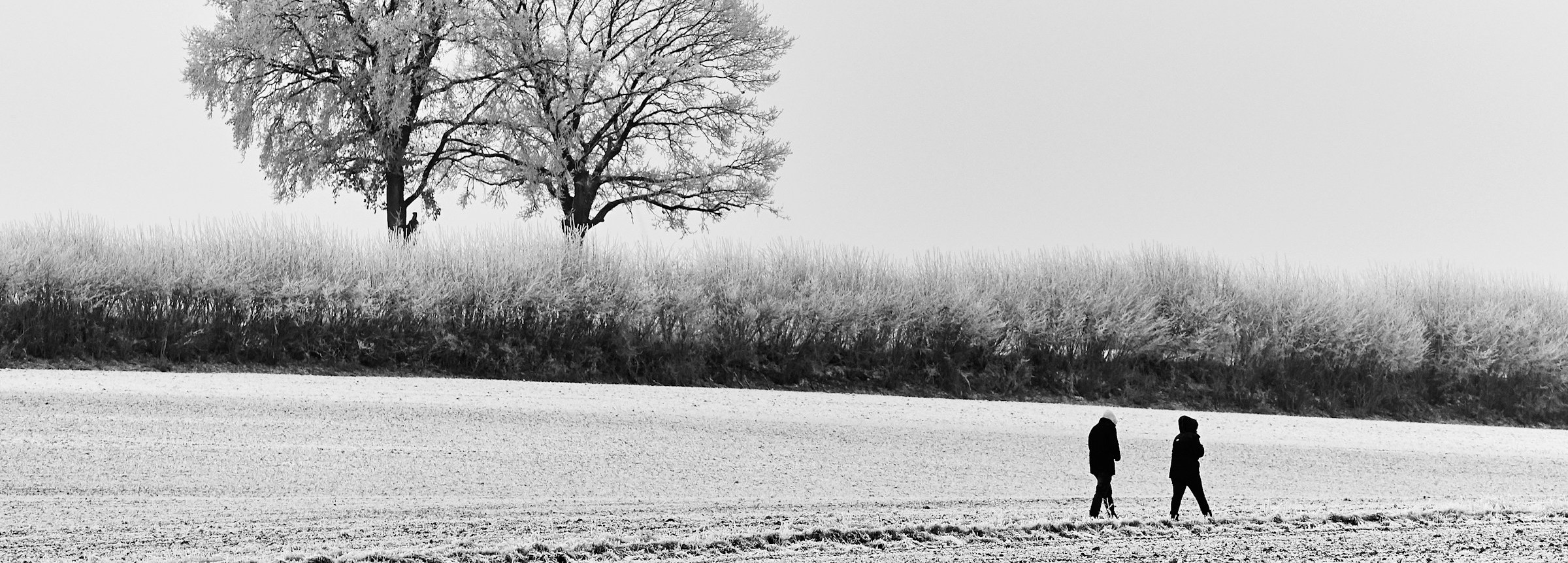
It’s November. It’s wet, and it’s getting cold.
This morning I walked round a lake. It was pond-like, the air misty, even milky, and during the whole walk the sun promised to slip through, but never quite did. Willows stood upright, sharp and distinct, like pencil drawings. Tiny, industrious birds flitted from the bush ahead to the next, and then the next, like a tease, or a dance. And every so often a call, clear and bright, which made us stop and crane our necks to see what was responsible.
As I walk, my pulse steadies and my breathing begins to match the steady pace of my footsteps. It feels good to be out in winter, a cold brisk walk, the rain on my face, even a little vitamin D. But while we might see it as some kind of prescription for better health, the urge to walk is so much more than this. Walking is a chance to leave the screens and home comforts behind us. It provides rhythm for the mind and much-needed recharge for the soul. Whether alone, or accompanied by a friend, the very act of stepping out of the front door can begin to solve many of our problems.
T.S. Eliot was wrong: November is the cruellest month. Warmth is a distant memory, yet Christmas is still miles away. There are snowdrops in February, and blackberries in October, but by November, all that’s left is mud and forgotten leaves. Walking is important at any time of year, but when the days are short, the light is low and the winter blues can hit, we need it more that ever.
I always wanted my boys to have as many experiences in the wild before they began to worry about the mortgage. Nature looks more wild and beautiful in winter: icy blasts in your face; wind that knocks you off your feet, the flare of evening light as you turn for home. The promise of snow.
There is a long history of artists who have been walkers. It’s estimated that Wordsworth walked around 180,000 miles, wandering lonely as a cloud. Charles Dickens took long walks to help him think before breakfast. Walking, says Rebecca Solnit, is how the body measures itself against the earth.
The rhythm of our swinging arms and legs somehow creates the perfect thinking balance in which mind, body and the world are in tune. While our attention is caught up with the scenery, we are free to think and our mind to wander. Walking stills the mind and helps to order our thoughts so that we create the headspace to catch ideas we thought we’d lost.
I enjoy listening to podcasts or music (or even Test Match Special) when I walk the dog, but this blocks out idle time and the chance to daydream, which is where many of our best ideas come from. For my brain to make productive, subconscious connections I need to put one foot in front of the other and hush the noise.
We live mostly at high speed, hopping between interiors, from home to work, from the gym to the supermarket. We sprint through our days at the kind of velocity that would astonish our grandparents.
I like walking because it is slow, and I suspect that the mind, like the feet works at about 3 mph. If this is so, then modern life is moving faster than the speed of thought, or thoughtfulness. Rebecca Solnit
One of the joys of walking is that you get out of your own head. When you are so focused on what’s under your feet or what’s coming around the next bend that there is no time for the usual rumination of work issues, or where exactly your parenting is going wrong or whether you are putting on weight.
I find that within the first few minutes of my walk my daily preoccupations evaporate, and I begin to be in the here, and now, feeling the earth under my feet, the brightness of the empty sky, and whether or not I recognise this or that small brown bird. For a precious hour, or so, I feel that I’m actually present in my own life, and nothing else – not the past, nor the future – holds the same meaning as that moment. This, says explorer Erling Kaage, is the secret held by all those who go by foot: life is prolonged when you walk. Walking actually expands time, taking us out of ourselves as we are swept up by nature. Walking is, to use a lovely phrase from Iris Murdoch, an occasion for unselfing.
The other day my youngest son told me that most evenings now he makes a short journey up to a cluster of fields near his house for a thirty-minute stroll at the end of the working day. Most people my age get pretty much no respite from the phone and content you don’t actively choose, he tells me. So, for him one of the best ways to escape this stream is to get out and walk at the close of the day. To reflect on the day was how he put it, without someone else telling him what to think. He’s been recovering from a period of illness, and walking has been a big part of his medicine.
We cannot of course escape all of our problems, but experience tells me that a few fall away with each step that we walk. Some dissolve as I reach for the boots. Most vanish within a thirty-minute dog walk. More tricky issues may take a day in the hills, while there are one or two difficulties that I’m still working over years of long walks.
I have walked myself into my best thoughts, and I know of no thought so burdensome that one cannot walk away from it. Kierkegaard
Mostly what walking and being alone in nature does, is to help me see a problem differently. The scale of the landscape begins to do something to the size of the experience I bring. The immensity of one shrinks the size of the other. So that by the end of the walk, it’s much less of an issue than I’d originally thought.
Walking is forward motion, a metaphor for steady progress. When you put one foot in front of the other, then at the end of the stroll look back over your shoulder, you see how far you’ve come. We walk to reach our destination, to battle winter, to get through difficult times. For me walking the walk is better than talking the talk. Steps, not words.
I love deciding what I need to take in my rucksack. Looking at the pile of clothes and food and maps and paring it back to the bare minimum, so my pack is light. As I walk, this gives me a sense of contentedness that life can be simpler. And, as the day proceeds, I begin to realise that, not only did I not need those things left on the bed, there’s stuff I brought with me that could have stayed there too. We always overpack. The whole idea with walking is mostly to leave stuff behind. The weight is physical, but it’s also psychological.
Back at home, simple pleasures become less real. Sensations which felt amazing outside – feeling full after a sandwich or thermos of hot soup, greeting a fellow walker after not seeing another person for hours, snoozing by the riverbank after lunch – can fade and become ordinary. They lack the bite of the outside. Going for walks simplifies my senses.
I often begin walks tentatively, wondering whether I really have the time to commit to it. My footsteps are less purposeful because I’m not all in yet. But my experience is that you have to walk just a little bit further than perhaps you were expecting to, or are comfortable with, in order to reach something better: the way-point, a summit, the best blackberry bush, a more satisfying view.
Of course walking with my dog helps me out of the door, but it’s myself I’m pleased with, for taking the walk, for committing to it and going further, when they were other pressing matters. Two weeks ago, I was out in a remote spot with my boys, and it was just ten minutes after we’d asked each other whether we should turn round, that we heard something scarily prehistoric, then stumbled upon a herd of stags, snorting and steaming in the frosty morning air.
This is the unexpected magic of walking in winter.
 ianfrosteducation