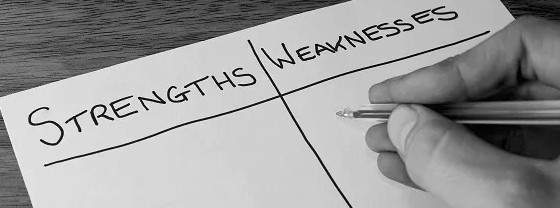
Whether it’s losing weight, getting off the phone, or trying to read more books, new year resolutions are mostly about fixing our weaknesses. It’s tempting to apply this preoccupation with our failings into work mode. But the beginning of the year is the best time to focus on our strengths and how we might develop these.
In the past, I used to draw up some kind of rough personal strengths and skills assessment in my head. I’d identify the areas I thought I was good at, like giving feedback to teachers, then put these to one side, imagining that they were somehow sorted. Then I would focus on the weaker areas, like financial planning. I’d then come up with all sorts of activities to try to make them better, like asking an expert, or reading books to fill me with the knowledge I knew was missing.
There are two things wrong with this approach.
The first thing is that by ignoring my strengths, I was missing out on becoming really good at the very things where I already possessed an edge. Economists say that a country has comparative advantage when it focuses on what it can do best, relative to others. If we apply this concept to ourselves, then personal advantage might describe the particular strengths where we develop excellence, compared to our colleagues. These capabilities become our superpowers when we spend more time fine-tuning them, in order to become more productive. By not developing my strengths, I’m missing out on reaching my potential. I’m settling for mediocrity.
The second (and more prosaic) thing wrong with this approach is that spending more of my week focusing on what I’m not very good at is perfectly miserable. What I thought might in fact be a productive thing to do, in reality means that I am forcing myself to engage in something I hate, and that others are better at. The more time I spend on this (especially in the dark weeks around New Year as part of some sort of resolution guilt regime), the more drained and demotivated I become. Working against the grain means I lose confidence and I’m less productive.
You can’t build performance on weaknesses. You can build only on strengths. Peter Drucker
In other words, we should spend more time developing and harnessing our strengths, and less time anxiously worrying about our weaknesses. Of course we want our weaknesses to improve, and at the beginning of our leadership journey broadening our skillset is certainly important. But there’s probably a law of diminishing returns operating here – I can get up to a basic level of compliance in my weaker areas, but any more time spent is probably a waste.
The more of the week I spend worrying about my gaps, the more I’ll see them. I become like the Tinman or the Scarecrow or the Lion in The Wizard of Oz, who can only see the one thing they’re missing – their heart, brain or nerve. This is the Baader-Meinhof principle playing out. When I focus on my weaknesses, I only discover more problems to be fixed, and my to-do list of inadequacy grows.
In Meditation for Mortals, Oliver Burkeman describes this feeling as, the sense of not having life nailed down yet, needing to exert oneself harder to avoid slipping further back. It’s never-ending.
Instead, when I spend more time utilising my strengths, I help colleagues more, I feel more motivated, I see greater success. I find myself enjoying concentrated periods of flow. By seizing control of my diary and making sure my days are not overwhelmed with the negative, I feel lighter and I’m more likely to flourish in my work. I’m closer to choosing joy.
We see more of what we focus on.
How does my team help?
Most of us experience the irrational fear that one day our colleagues will discover our mistakes and uncover our weaknesses. The truth is that most colleagues simply want to focus on what we are best at. People love us for our strengths, and when they are thinking about us, it’s this. This is good news!
We can’t all be good at everything, or all things to all people, and this is of course one of the most helpful elements of being part of a team. Teams function most effectively if we each work on the things we are best at. If, like me, you find this truth difficult to believe at a deep level, think for a moment about other members of your team. Would you rather they invest their time in the things they’re good at, or waste it on the things they find hard?
Where the idea of comparative advantage and resources falls short is that countries are in competition. Colleagues in teams are not. It’s in all of our interests for everyone to work to their strengths. It’s not a zero-sum, because you succeed therefore I must fail model. If we think of our strengths as resources then together we have unlimited resources, just as we have unlimited potential. In this way, when everyone works to their strengths, everyone wins.
A flourishing approach to resources can only ever be collective. Swaner & Wolfe 2021
When I build happily on my strengths, I learn in leaps and bounds, becoming more expert and confident and wanting to share this expansively with others, multiplying our resources. When I grudgingly chip away at my weaknesses, I’m a more reluctant learner, making less headway and less likely to share my learning with others, who I imagine to be better at this. Resources dwindle.
We’re often working at the wrong things, instead of the strengths at which we might excel. Imagine once the team is formed (with psychological safety securely in place), your HR director throws up in the air the individual job descriptions and moves roles around according to where people’s strengths really lie, not just the historic jobs to which each colleague applied.
It can be hard to focus on strengths because some line managers apply the approach of let’s fix your weaknesses. At best they genuinely want to help, at worst they want to show their own line manager the difference they’re making. Focusing on their colleague’s strengths, however, requires a much more subtle approach, involving more listening, where it is less about me (how can I fix you?) and more about them (how good could you be?).
What should training look like?
There is plenty of research on how a strength-based approach to leadership and professional development can have a highly positive impact on the performance and well-being of leaders (Dutreuil 2016), and on leading to more authentic leader behaviours (MacKie 2016).
Which of the following do you think would have most impact on your organisation:
– If you spent 80% of training time on making strengths stronger, and only 20% on improving weaknesses, or
– If you spent 80% of colleagues’ time on improving weaknesses and only 20% on making strengths stronger?
And if you are responsible for professional development, it’s worth thinking about what it is exactly that you are trying to achieve. Is my job to help minimise people’s weaknesses, or amplify their strengths? Am I trying to help ‘fix’ people’s problems, or is our training about helping them to flourish and fly?
We all want to be happier at work. If you feel like you’re working against the grain, take a look at the proportion of the week you are working on your strengths. And encourage your team to focus more on theirs too.
 ianfrosteducation