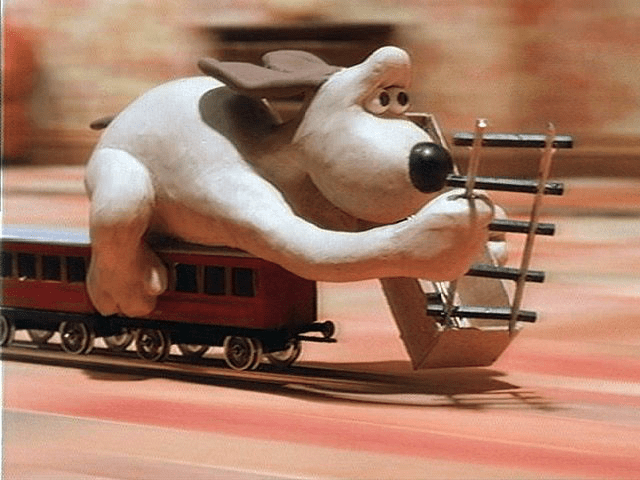
I love that scene towards the finale of The Wrong Trousers where our heroes Wallace and Gromit are riding the runaway train and both realise the rails beneath them have run out. Gromit reaches out to grab a pile of track, and then at super speed lays it piece by piece, as though dealing cards in a casino. Not only do they avoid a crash, they catch the menacing penguin jewel thief, Feathers McGraw, trapping him neatly in a glass milk bottle before arriving in a crumpled and happy heap.
All of which plasticine mayhem takes me back to happy hours building Brio with my boys, clicking together Scalextric as a kid and even watching my Dad lay down foam underlay beneath the Hornby train set in the attic. Less happily, it reminds me of the way we often find ourselves desperately laying track to keep us on the leadership rails and avoid things uncoupling.
We live in uncertain times. Everything seems like it’s speeding up or becoming increasingly complex, with demands coming at us faster than the team can manage. In a recent road map graphic here, the DFE announced there would be twenty-five policy changes expected to hit educators over the next twelve months. This amount of change, on top of a demanding role, after a year marked by a rushed new inspection framework is unrealistic. We aren’t sure whether we should solve the crises of today, or worry about the issues of tomorrow and what’s coming down the track. This short-sighted approach to change is unkind, unfair and actually feels a little unsafe. Someone might get hurt. In any other sector people would be complaining.
This isn’t new, of course. I remember the first time I’d heard the analogy of building the aircraft while it is in the air, back in 2008 when the 14–19 Diplomas were being rolled out at ridiculous speed. No one was ready. Last year there was Ofsted’s unseemly haste in rushing out an unready inspection framework. Leora Cruddas, CEO of the Confederation of School Trusts, recently wrote:
These multiple pressures on our schools are creating system fragility. We need the government to work with us to build the resilience of the school system. We need government to recognise its duty of care to our children, young people and families.
Uncertainty and change scatters our thinking and take our attention away from our core business. I used to feel that a major part of my job was to bring some certainty and some order to protect the people around me from the chaos of the externals. I wrote this and this to try to help school leaders make better decisions. But I realise that this can only ever go so far.
It seems the key trait we expect of school leaders today is not making the best possible decisions with the resources available, but making the least worst decisions in the face of unrealistic demands.
This ability to navigate ambiguity and change is now part of the toolkit for leading well. We all need to be, well, a little more Gromit.
So, in the light of all this uncertainty, what does laying track look like?
Maybe it is acknowledging that we don’t dance to the tune of the DFE or the regulator. That your trusted cycles of strategic planning and budget monitoring and school improvement do not simply shrivel up in the face of the next initiative. That you actually know what you are doing and when to say enough.
Maybe it is recognising that while progress sometimes feels glacially slow, it is in fact happening: The much-quoted words from Theodore Roosevelt, credit belongs person in the arena, whose face is marred by dust and sweat and blood… make the job of a leader sound glamorous, but the truth is most of the daily work is unseen. It is being brave enough to step into the arena, but at the same time recognise that those seeds we sow every day are tiny, and our actions far from gladiatorial.
Maybe it is recognising that since someone has to plant those seeds, it may as well be me. The seeds of consistently good teaching, well-managed budgets, effective professional development, trusted HR processes, all sit behind effective school improvement. These are the elements of reliable and positive change, and they don’t happen automatically.
Maybe it is recognising we lead in that space of having to do more with less. That while there’s not enough money to pay for the support which my children deserve, or the interventions they require, or the teaching assistants I need, these children are in front of me right now, so I need to make decisions inside this uncertainty.
Maybe it is being prepared to bring some truth: to manage a complaint while at the same time helping the parent to see that their response is not helping. In a world where social institutions have tumbled, parents have fewer and fewer professionals who physically meet them, listen to them, and who are prepared also to tell them the truth.
Leading through change and uncertainty is like this. You are having to work at speed, make decisions with incomplete knowledge. Sometimes you feel only a couple of steps ahead of the game, and often not even that. What your team want isn’t clever strategy or blue-sky thinking, but just that you picked up the phone, that you showed up, that you were there in the difficult moments – when parents challenge, in the staffing crises, when behaviour doesn’t feel safe. There even when you aren’t sure that you have the answers. In fact, especially then.
So how might we manage uncertainty better?
1/ Keep moving forwards
When laying track, the trick is to keep moving forwards. Each day’s quota builds on the last. Just getting stuff done helps kill our perfectionist mentality. In The Artist’s Way, Julia Cameron uses the term laying track to describe a way of working in forward motion, on a draft of whatever you are working on, without stopping to edit, or look behind you all the time. Small steps add up, and as you build up these drafts you inch forwards.
While the educational landscape is constantly shifting beneath you, your team is looking to you to understand what’s going on, help them prioritise the incoming, to know what’s important and what’s not. Laying track means that you don’t have to know all the answers. What matters is that you keep moving forwards.
2/ Frame the uncertainty
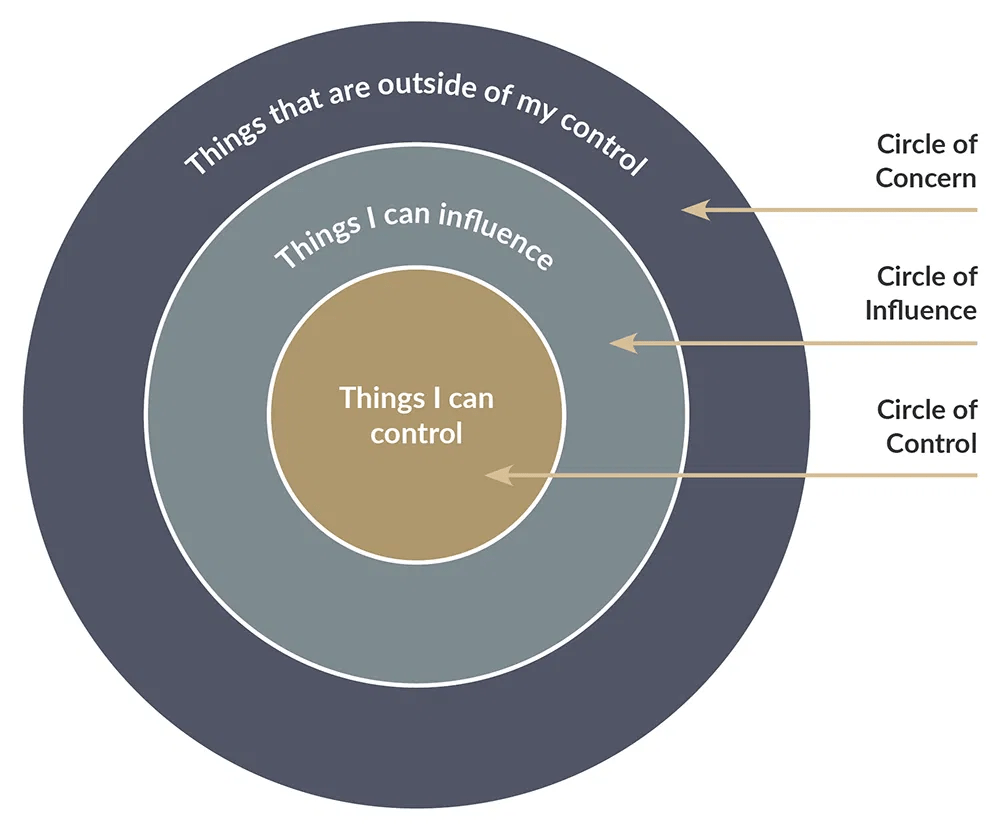
Many of the external pressures that make us anxious at work are clearly beyond our control, yet we find ourselves unable to stop worrying about them, and this depletes our limited energy. The circles of control framework, devised by Stephen Covey, visualizes three concentric circles, representing: a) what we can control, b) what we have influence over, and c) what is simply beyond us. Having this knowledge can help focus our energy.
PositivePsychology.com
The inner circle of control contains everything directly within our power. This is our immediate short-term work, and our area of mastery. This is where you should invest our time.
We do not have direct control over the middle circle of influence but our actions still have impact. Here, we can influence through the quality of our conversations, the way we build relationships, by checking in, through our skills of persuasion and negotiation.
The outer circle of concern is, frustratingly for all of us, usually the biggest zone. These externals which affect you, but over which you have absolutely no control. Here you find the depressing world news, the way government policy frustrates your work, even the curse of your previous mistakes. The best advice here is to try to reach a state of acceptance, where we can acknowledge these problems exist, but try to separate them from our daily mood.
The model is helpful, because, by moving our focus from what’s out of our control to what might be within it, we lower our anxiety. It can also encourage us to become more proactive, because we move from passive complaining about the circle of concern, into problem-solving within the circle of influence.
For example, in my role as subject leader, there is plenty in my control, where I’m an expert, from choice of curriculum materials or exam board, to how rewards and sanctions will be applied and how I run my 1:1s. Beyond this are the areas I have less control over: I’m never certain what personnel issues may arise, whether I will lose colleagues to jobs elsewhere, or how exam results or option numbers will impact decisions for next year.
In my role as a pastoral leader or phase lead, it’s my circle of influence which becomes so much more significant in how I might lead. Each of my team, however committed they are to our joint purpose, all teach in departments and this is their main calling. Therefore, I need to think about how I might more successfully influence the team, in our meetings, through my praise and my modelling.
As a school leader, I’m acutely aware of the externals, and how they press down on me and influence my thinking. Whether it’s the policy changes, popularity of nearby schools, or pressure from the DFE because of my attendance data – I have less immediate personal control over these but they sure affect my levels of anxiety.
This is why when you look at the trajectory of most leadership journeys over time, we seem to deal with more uncertainty the more responsibility we take on.
3/ Widen your decision-making
There are times, of course, when like Gromit, you reach for the next piece of track, the perfectly shaped curve which you know is just the right piece to get you out of trouble, only to find it’s not there. And there are no instructions for what to do next. Unless you’ve experienced the feeling of sitting in the school leader’s seat it’s hard to describe that precarious balance between deep privilege and silent terror. No one knows exactly what the future looks like, yet you’re the one who has to make decisions inside that void.
In The Comfort Book, Matt Haig says reminds us that since everything in life is uncertain, instead of being permanently frustrated by it, we should see the value in uncertainty. Rather than being a curse, it can actually be a source of hope. While the things we are looking forward to might not be as good as we would like, the things we dread might not be as terrible as we’d imagined:
At some point, in any life, something bad will happen, and it is the inherent uncertainty of what that bad thing will ultimately mean to you, what it will lead to, and what it will reveal, that enables us to have a more enduring and resilient kind of hope.
Decision-making in periods of uncertainty is a balance of the things we can measure (budgets, data and risk), and our human emotions (gut-feeling, moral purpose and our fears) too. Most of us would rather wait for certainty before making a decision, but often the most effective leaders are those prepared to step into the space where others fear to tread.
Voicing your fears isn’t weakness. In periods of uncertainty, talking honestly about present reality is so much more empowering for our teams than bland optimism (false hope). When we talk openly about the uncertain landscape, this can remove some of the fear. Schools and Trusts are often stuck in a pattern of cognitive hierarchy, so they benefit by seeing the process of decision-making as more of a team game. Building powerful routines which enable the input of staff surveys, team members, governors and trustees to enrich our questions can help us make more powerful decisions because they are shared.
4/ Communicate more than you think
My tendency is to communicate strongly when I’m confident, but then go quiet when I’m less clear about the future or am waiting for advice. But I’ve learnt to be less fearful. People need well communicated direction especially in the least certain circumstances. Imperfect (but honest) direction is better than silence. Leading effectively, from your values when facing uncertainty and difficulty is easier when we have guiding principles which are brave enough to be hopeful about our destination, but not over-prescriptive about the journey. This provides a foundation from which we can lead our team forwards.
As you make yourself communicate more, you become more clear about your purpose and rationale, despite the challenge you face (low attendance, Y6 or Y11 outcomes, pupil numbers falling). You recognize there is no how-to guide for the particular situation in which you find yourself, yet, despite this, you face the challenge. You consult and listen, and while there certainly moments when you get it wrong and need to course-correct, the ultimate destination and your purpose remain fixed.
It helps to be clear about exactly what is changing, and what is staying the same. It can be really encouraging to hear that our tried and tested routines are exactly what we will carry on doing, irrespective of externals. People around you will wobble. They may worry about their role, their responsibility or even their job, so check in more often and provide regular updates for your team about where you are going. The moment that you feel you are over- communicating is probably when it’s about right.
Leading through uncertainty, according to author David Brooks, requires shifting away from technical decision-making in favour of deep interpersonal connection, where we build trust. We more successfully navigate ambiguous times, he argues, by being more human-centered.
5/ Embrace your doubts
Some leaders, when things are moving quickly, pull in the reins and take charge. Their language becomes more about them and being in charge, often in a genuine attempt to bring certainty and reassurance. But I think what people require right now is a different approach. John Keats described the feeling of being capable of living alongside uncertainty, mystery and doubt, without any irritable reaching after fact and reason. He called this negative capability. We mostly think of the word uncertainty as a negative. But we need to remember that what new people mostly bring is new ideas and unexpected perspectives which can enrich our lives in so many ways. This approach of continuous learning discourages arrogance and encourages personal growth.
In Philip Pullman’s His Dark Materials, the main character, Lyra applies the principle of negative capability to the way she uses the Golden Compass. When she sits long enough with the compass without pushing for an immediate solution, answers slowly come to her. Because doubts make us feel uncomfortable, we often brush them away and focus instead on the things that are fixed and we are certain about. Taking a little time to get familiar with our doubts may teach us what it is we have actually been avoiding, or perhaps what remains unexplored.
Uncertainty and risk are inextricably linked with mystery and yet unexamined potential. They may lead to discoveries that we would not have otherwise have made. Rosemary Lain-Priestley
6/ Tell more hopeful stories
During the pandemic, Rebecca Solnit in No Straight Road Gets You There, we were living in the middle of a story. Because the parents of her nephews and nieces were stuck and couldn’t mix as households, Solnit began reading fairytales to them all online. Reading stories was a way of being with people (while we couldn’t be with many people), because fairytales reassure children that there is a definitive outcome: genies come out of lamps, princesses ultimately escape towers. When we are in the middle of a period of deep uncertainty then any sort of happy ending is not in sight. To live in the middle of a story is to live in suspense and uncertainty about what will happen.
Hope is inextricable from uncertainty, because while we don’t know what will happen, this vacuum can offer the space to participate in how the future plays out. Leading through uncertainty may be less about strong new vision and direction, and more about bringing a calm steadiness. It may start with understanding ourselves as leaders better, embracing our doubts and thinking before acting. Uncertainty may be less scary than we at first think, can provide a perspective for the best way to lead, and guess what, we may even become stronger as a result of facing it.

