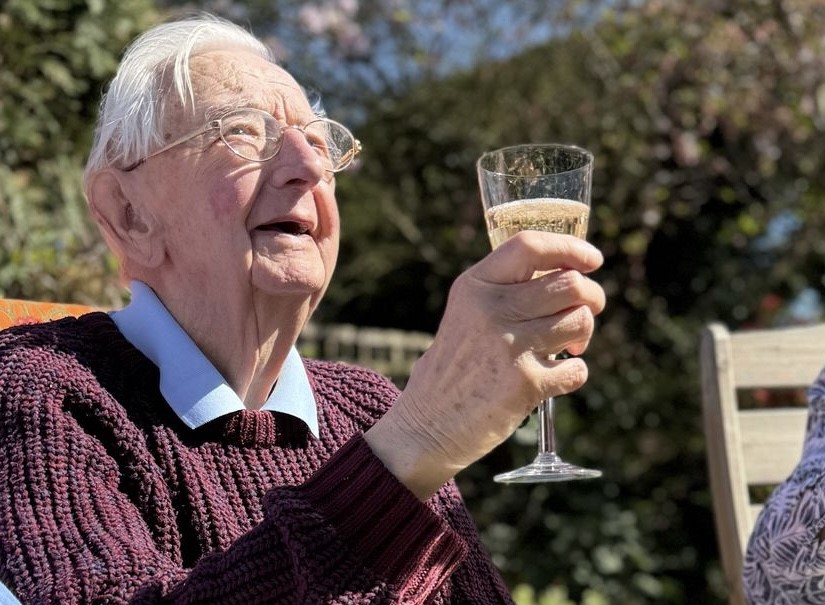
I’m one of four boys, who have just lost their father, very soon after losing their Mum. As a father myself, I have two sons in their twenties. And as a school leader for more than 30 years, a question I often ask myself is, what kind of men do we want our boys to become?
We lost Mum to a stroke eight weeks ago, and then moved Dad to a care home to be closer to his boys. But after only five weeks he fell and broke his hip so couldn’t be at Mum’s funeral. He developed pneumonia in hospital and never recovered. Their funerals were only 3 weeks apart. Until we lost Mum, they’d been married for 67 years, then separated for 6 weeks, and now back together again.
Even when they’ve reached old age, losing both of your parents close together is hard. But right now, beyond the grief, there is an overwhelming sense of relief to have made it through two parent funerals inside a month. We have a WhatsApp chat called Frost Generations Family, and, in the space of five short weeks, we’ve lost one of those generations. The anchor that was always there in the background is gone, and I feel a bit untethered.
Dad had cared for Mum – who at the end had dementia and bowel cancer – cooking and cleaning for the last three or four years. His loyalty to her was touching. At first, it meant not using the D-word with us. When we played cards, he’d pretend he couldn’t remember which suit was trumps, to cover for her. When we rang, he’d say how well they were managing, knew we were all miles away and didn’t want to trouble us. Later, there was the dilemma of us knowing things weren’t right but having to let go because they were in their own home, respecting that they were making their own decisions. Until you finally realise they’re eating cake for breakfast, lunch and tea, the loos need industrial work, and you know you need to step in. It’s a tricky phase where you are just trying to make a least–worst decision.
So, in truth, losing them happened in stages – at every point where Dad or Mum began to lose control: the introduction of cleaners, then carers, the symbolic confiscation of the car keys. These were small goodbyes. For Dad, this meant the drawing in of his titanic energy and the gradual passing of control to his sons. While this was sometimes tricky to navigate, throughout it all he remained dignified, touching, witty to the end.
At Dad’s funeral wake, my brothers and I had conversations with people we had no idea Dad had supported and encouraged. From bishops to batsmen to bookkeepers, he’d clearly impacted lives in ways we simply hadn’t appreciated. Men and women had driven miles to be there, to pay their respects, to share snatched words over a plate of sandwiches, when a whole life opens up to you. You suddenly get a sense of your parent’s other life. You widen your Mum or Dad weekend lens and see them in their weekly community.
As a father you know that you want to be a good role model for your sons, yet you know you will sometimes fail in this pursuit. You want to show them what a good relationship can look like, but you know they’ll see and hear every raised voice or unkind word that you and your partner share. You want to be a parent not a friend, yet when they’re grown up you hope they’ll choose to sometimes holiday with you. You want to model passion for your life’s work so that they find their own direction, yet you know they see you at your worst professional moments. You want them to respect you as a father, but you also want them to laugh at you because you are, like all good Dads, completely out of touch. You want them to develop healthy relationships with other men and women your age so that they hear the wisdom of ‘uncles’ and ‘aunties,’ as they forge their own identity. But you also want them to know that when all else fails, when there’s nowhere else to go, they can come home.
Dad was born on the 4thApril 1935, at 6 Spur Road in Tottenham and went to school in White Hart Lane, so there was never really any doubt which football team he’d support. He was four when the second world war broke out. Mum became a history/RE teacher and Dad began his ministry in the 1960s. Both worked in schools and parishes with plenty of social challenge.
As we grew up, we’d watch Mum and Dad chatting head to head, whether this was discussing what to plant next in the flower beds, or planning the next mountain in the Lake District, or pouring over their wildflower guide on long country walks – which at the time seemed utterly boring for little boys desperate to kick a ball around yet now looking back seems gloriously romantic. They were a joint team, there was always lots of discussion and plenty of saying sorry, which of course as kids you see at close hand.
Many boys, when they’re young, want to be their dad. We stand our tiny feet in their oversized shoes, rub their bristles we can’t yet grow, climb on their back for them to carry us around the garden while we roar like lions. Then as we grow up, we want to be anything but. We highlight their faults, and rebel. Finally, somewhere between the ages of 17 and 60, when our measure of the father we had is moderated by our own tricky experience of being a parent, we soften our hard line. We forget the few flaws and grasp the many gifts. The laughter and fun. His extraordinary energy. The way he made you feel like you were the only person in the room.
I remember sitting with my dad polishing shoes together when I was young, and remember him saying: ‘If a job’s worth doing, it’s worth doing well!’ when I was clearly about to short-circuit the chore. As I grew up our best conversations were often the unexpected side-by-side moments: fixing a puncture together, walking the dog, sitting in the car just him and me – where there was no pressure, and it was safe to open up in my own time.
I remember a similar moment with my own youngest son, walking with the dog for our one exercise routine of the day during Covid. As we walked alongside me, he described his frustrations: his anger about paying for university course he wasn’t getting, rent for a flat he wasn’t living in, and the impact all of this might have on his career and his bank balance. I tried to stop myself making suggestions. I breathed out, shut up and listened to my son. At one point the spring light shone through a wooded bank of wild garlic. We both just stood and watched for a bit, saying nothing. And then, slowly, as we meandered back to the car, side by side, a train of half-formed ideas and future plans emerged as he talked. How he might use this period. The yawning time ahead slowly seemed less a punishment and more a new possibility. I don’t think I spoke for half an hour.
A couple of weeks ago I asked him to tell me about his memories of Grandad. The first thing was learning the piano when Grandad would cover up his fingers, to get him to read the music on the page in front of him instead of looking down at his hands. He loved watching his grandchildren practising their scales and pieces, and in the last weeks before we lost George, his grandsons played duets with grandad in his new care home. At Dad’s funeral in Lichfield Cathedral, my eldest played a Chopin etude – the last piece he played for him.
My Dad loved poetry and literature, and talking about this with him was my first inspiration to write. This became a running theme through my childhood – sharing poetry, talking about Hamlet (my A level study), or Saturday’s Tottenham Hotspur results. Later in life I’d send him my blog drafts to proof-read with his hard-nosed editorial pen.
It must’ve been challenging to stand up and preach with your four critical teenage sons sitting in the pew, arms crossed, ready to spot any hypocrisy. Our image of God as father can be damaged by a negative experience of our earthly version. Dad was very human, and not every aspect of his parenting did we adopt for our own, but in the main we were blessed by a father who was encouraging, laughed loud and long, and was always physically affectionate with his four boys.
There is from his boys, of course, a sense of deep gratitude.
Gratitude for growing up within an atmosphere of unconditional love and laughter.
Gratitude for those who helped them as they aged. For the kindness of neighbours who cared for Mum and Dad when we weren’t around. They say it takes a village to raise a child. I think it takes a whole community of practical love to make sure we look after each other as we get old. One of the real frustrations of this period is that we were trying to do our best for our parents from miles away, while managing a job and the needs of your own growing children too. Being sandwiched between two generations who each need you in different ways, can leave you feeling you’ll never be able to do or be enough. You are both absent son, and less available father.
Gratitude for the NHS staff at every level at Derby Royal and at Swindon GWH. Even at the end they wouldn’t be kept apart – when Mum was admitted into the stroke unit in Derby, Dad was also checked in, and stayed there, rather touchingly in the bed next to her. Who says there’s no romance left in the NHS?
Making decisions for both of your parents about end-of-life care back-to-back is hard. I can still feel Dad’s hands clinging on to mine, desperate for physical touch. As he was slipping away physically, in those special last two or three days, his boys there, talking, praying and holding him. And then suddenly he is no longer there in the room with you. He’s gone.
I’m stepping away from my job, and this whole period has been a challenge. I share this personal post partly because we’re all dealing with the balancing act of our personal lives and the job. It’s always complicated and often messy. Although my team were brilliant, it was hard to focus when stepping back into work. You know this will never happen again, that you have to spend time getting this right. You can’t short circuit it.
We all feel the undeniable print of our parents on our own lives, on the people we become, on the way we are at work, and on our own subsequent parenting. The role reversal of the last two-plus years has certainly taught us boys much about patience, giving back and appreciating the lasting influence of lives well-lived. Let’s hope that some of their sense of daily joy and encouragement has rubbed off too.
Bereavement is complex. At times we shrink into our shell nursing our grief, at others we feel ready to reach out and carry their love and life forwards into the future. It’s important to feel sad about who and what we have lost, but at the same time grateful that this was shared at all. I had a moment this week when I was puzzling something out and said to myself, it’s OK I’ll have a chat with Dad about it. What I would give for an afternoon cuppa with him right now.
On my phone I have a recording that I took four weeks ago, the last time Dad played the piano in the care home with my eldest son. They’re partly focused on getting the notes right from Consider Yourself. But most of the time they’re laughing. Thanks Dad, for your wonderful legacy. May you rest in peace.
. . . . . . . . .
We are so grateful to Dr Alan Smith, Bishop of St Albans and close former colleague of Dad’s, for writing about Dad’s ministry in this obituary for the Church Times.


Sorry for your loss, but very touching to read about your father, whom I have not met… but feel like I have from these words! I once read that grief is the price of love… boy aren’t we lucky to have had these wonderful, stoic people in our lives? They have given us so much more than anything material can bring. We just have to let them live on inside us…. That’s the greatest gift back to them ❤️
LikeLike